Thursday, April 6, 2017

Learning Challenge: Reading and watching!

Reading and watching/listening. If you are watching a movie on TV, you probably have the option to turn on English subtitles. Turn on the subtitles and see how that mix of listening and reading works for you. How is the experience different when you are both hearing and seeing the words? Do you like watching the captions turned on, or do you not like it? If you are watching together with someone else, compare your experiences. Do they have the same reaction that you do?
For this week, I want to do the "Learning by HEART" challenge for reading!

So whenever I watch a TV show or movie, if I have the option to, I always turn on the subtitles. A large part of my ability to comprehend others comes from me reading their lips. It's not that my ears are particularly bad, but sometimes, I cannot distinguish words well if I am not looking at the person directly. By both being able to hear and see the words, I can understand what is going on much better. A few people that I have met actually do not like because they say it distracts them from the actual movie since the words keep scrolling or changing. For myself, since I can read pretty quickly, it doesn't bother me much since it takes less than half a second for me to read the sentence and continue watching the scene.


"Book with pages folded into a heart."
Source: Treehugger.

Week 11 Storytelling: To Suffer? Or to Live?

A soft breeze. The blades of grass softly grazing his skin. The shadow of the bodhi tree casting a shadow over his body while protecting him from the harsh rays of sunlight around him. 

Lotus art. 

Siddhartha breathed in deeply and slowly through his nose. He noticed the scent of the air around him. The way the air traveled into his body. The way his chest rose and fell and with each breath he took. This was it. This was what he spent a large part of his life searching for: freedom from the suffering of the world. From the moment he became the Buddha, Siddhartha lived each day with splendor and compassion. He was a part of the world and at the same time, the world was a part of him. 

He let his mind settle into quiet meditation and felt the rest of his body melt away as the physical senses were not important any longer. It was simply himself and his mind. But for some reason, this time it was different. Instead of casting complete stillness and silence over everything, his mind's eye was casting a faint light. Thinking nothing of it and willing it to melt away, Siddhartha continued to focus on his breathing. The light had no intention of fading away, and instead, it got even brighter. Brighter and brighter, still, it became until a scene appeared in front of him. It seems that he was looking in on something happening as an omnipotent presence. 

He saw himself in the arms of his mother. Although he was still newly born, he knew that the baby in the arms of one of the most beautiful women in history was him. Inexplicable yet sure, he looked on. Somehow, the scene sped up and he was no longer a baby. He was a young boy, barely past the age of 10, running into the arms of his mother. His mother? What was she doing here? He was told she passed when he was barely a week old...

The scene sped up yet again, going further than it did before. The younger version of him was walking down the road where he remembered seeing the three men who helped realize the suffering in the world. Yet, the sick man was not there. The old man was not there and neither was the dead man. The roads were empty and void of people or any person who seemed to be suffering an ailments. Puzzled, Siddhartha looked at the younger him once again to see a young man who was simply happily strolling through his kingdom. 

The next scene was his coronation as the next king. He saw his father look upon him with proud eyes. His mother was right by his side holding his hand. Somehow, what he was seeing did not make sense any longer. What was happening? Why was his mind showing him this story which made no sense and followed a completely different trajectory than what actually happened?

The final scene. He saw himself, as a 60-year-old man, crying next to a bed. Walking over to see who was on the bed, he saw his parents. The older him was in tears while holding the hand of his father, who had quite obviously passed away. His mother was sick in the other bed, hanging onto the last thread of life. He, himself, was suffering the aching bones and the hunched stature that came with old age. 

Ah... Siddhartha came to a realization. If the gods had not forced him to see the true nature of life, this is the life he would have led. He would have lived to become a great king, but a king who had no idea what it meant to live life to its fullest potential and to fully understand that to live... is to suffer. 

Author's note: So I was reading about the life of the Buddha this week for the class and I really enjoyed it. In the story, it was told that when the sheltered Siddhartha chose to venture outside of his kingdom to explore, the gods were jealous of his happiness and showed him the three most harsh types of suffering in life: sickness, old age, and death. It was through that experience that Siddhartha left his home and went on a journey to become the Buddha and to learn that everything in life is, in actuality, suffering. I wanted to write a story where Siddhartha was able to see what his life would have been like if he never went through that experience. I wanted to pose the scenery to be similar to what the Scrooge in The Christmas Carol was able to see what happens in the future--kind of like he was looking in on what would happen in a ghost-like yet omnipresent state. And so in the end of this story, Siddhartha realized that either way, he would have had to experienced all the suffering at the same time, but never have the chance or the time to fully process it and become the Buddha. 

Title: The Life of Buddha
Author: Andre Ferdinand Herold
Translator: Paul C. Blum
Year: 1922


Wednesday, April 5, 2017

Growth Mindset: We All Struggle

"We All Struggle."

I agree with this growth mindset quote so much because life is about struggling. Without struggles, you wouldn't be who you are today. It would be great if someone was able to go through life without lifting a single finger or having others waiting on their beck and call. However, that person will be like a tadpole in a lake. That tadpole will never know that there is a whole other world outside of that lake. Because a person goes through struggles and hardships, he or she will be able to transform (to go along with this metaphor) into a frog that is able to go on land and see everything the world has to offer.

Growth Mindset: Difficult is Not Impossible

"Difficult is not possible."

This is one of my favorite quotes. As someone who usually puts 110% into everything that I am passionate about, I believe that anything is possible. Even though in the moment, it feels like it is so difficult to do something, there are always going to be other options or routes to get to the same destination. Also, it might seem impossible due to timing but one way or another, you are always going to get to where you need or want to be. This is something that I think everyone needs to realize because people get hung up about getting something done because their mind makes them think that it's impossible, but as long as they can take everything slowly and step-by-step, then it will always work out in the long run. 

Tuesday, April 4, 2017

Reading Notes: The Life of Buddha Part C


  • He entered the hermitage of the holy Arata Kalama, but chose not to teach his doctrine 
    • because "who knows it will not find deliverance"
  • His mother, in the heavens, actually came back to visit him once she thought he was dead
    • I think it'd be interesting to write a story from his mother's point of view
  • he had 5 disciples join him originally, but they eventually left him because they thought he lost his practice 
  • here, Mara is "the evil one"
  • a golden bowl signaled his ascension into Buddha-hood and he sat beneath the tree of knowledge
  • Mara tries to fight the Buddha, who honestly is just sitting underneath a bodhi tree trying to be peaceful
  • Siddhartha becomes the Buddha after the "fighting event" and realizes that "by leading a life of holiness, desire is stifled, and we cease to endure birth and suffering."
Mara.
Source: Smite.

Title: The Life of Buddha
Author: Andre Ferdinand Herold
Translator: Paul C. Blum
Year: 1922


Monday, April 3, 2017

Reading Notes: The Life of Buddha Part B


  • for a long time, prince Siddhartha lived a life of luxury, not knowing suffering
  • he even had a son named Rahula
  • one day, the prince decided to venture our of his home 
  • his father ordered for all the beggars and the sick to be removed from the streets so that Siddhartha wouldn't have to witness all of it 
  • the Gods interfered by showing the prince a sick man, an old man, and a dead man
  • Siddhartha was greatly bothered by what he had seen
  • he then chose to become a monk
  • my favorite quote: when someone is trying to escape from a burning house, we should not hinder him. the day comes, inevitably, when we must leave this world, but what merits is there in a forced separation? A voluntary separation is far better. 
  • he left his home for good
  • all of his family and friends were so sad they they died--including his horse :(
    Lord Buddha leaving the palace and his family behind. 
    Source: Yadavhistory.


Title: The Life of Buddha
Author: Andre Ferdinand Herold
Translator: Paul C. Blum
Year: 1922

Reading Notes: The Life of Buddha Part A


  • Suddhodana was the king of the city 
  • He actually had many wives, but his favorite was Maya 
    • she was an amazing woman: virtuous, truthful, attentive, and beautiful 
  • Maya requested to retreat to the forest
  • Maya became pregnant with "he who seeks supreme knowledge" 
    • she was chosen due to her noble character
  • She gave birth to the Buddha
    • okay at this point, I'm a little unsure of how this happened
    • the text went like, "suddenly, she stood very still. she smiled, and the maidens who were near her received a lovely child into their arms."
    • like what? did the baby just drop like a missile? 
  • I'm interested in writing a story where Siddhartha visits a parallel universe and finds how his life would have been if he were to have not witness all of the suffering of the world and left his home to find enlightenment
  • I'm rather confused at the scene where they're talking about the sixty four varieties of script
    • what realization did Visvamitra come upon to where he realized he couldn't teach Siddhartha?
    • It seems I didn't understand in the beginning. It was not Vismvamitra who read out the names of the scripts, it was Siddhartha himself. 
  • In the end, he wins Gopa's hand in marriage through all of his mental and physical prowess
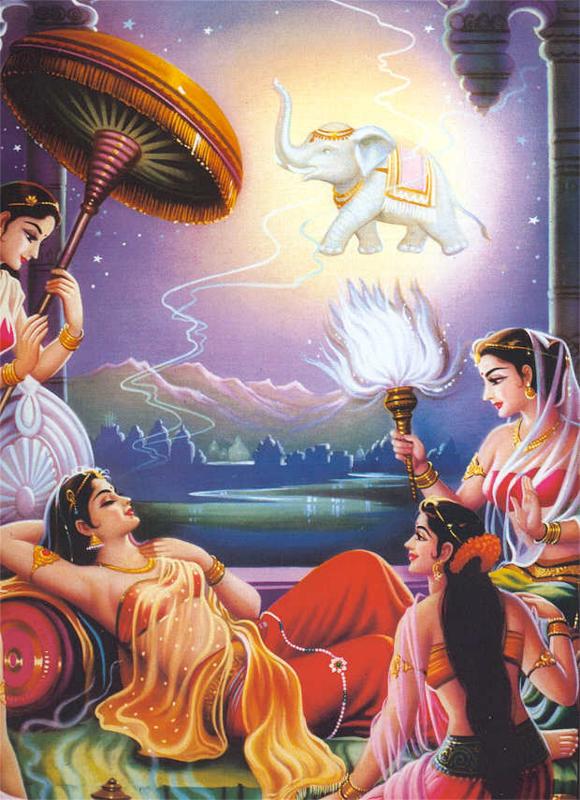
Maya dreams of the elephant.
Source: Alchetron.
Title: The Life of Buddha
Author: Andre Ferdinand Herold
Translator: Paul C. Blum
Year: 1922