Showing posts with label Wikipedia. Show all posts

Monday, April 10, 2017

Wikipedia Trail: from visual poetry to the wonders of the world

Visual Poetry
Poetry where visual elements predominate.

Example of visual poetry.
Source: Wikipedia.


Concrete Poetry
Poetry where "arrangement of linguistic elements in which the typographical effect is more important in conveying meaning than verbal significance." Also known as color, pattern, or shape poetry.

Alexandria
The second largest city in Egypt, founded by Alexander the Great.

Wonders of the World
A list of the world's most splendid natural or man-made structures. Includes the Great Pyramid of Giza, Hanging Gardens of Babylon, Temple of Artemis, Statue of Zeus, Mausoleum at Halicarnassus, Colossus of Rhodes, and Lighthouse of Alexandria.

Sunday, April 9, 2017

Wikipedia Trails: from Grimms' Fairy Tales to Sine qua non

Grimms' Fairy Tales
A book that contained a collection of German fairy tales.

Rapunzel
A fairytale in the Brothers Grimm collection which tells of a girl with long hair trapped in a tower.

Aarne–Thompson classification systems
This is the system used to classify folktales.

Sine qua non
This is a phrase for "without which there is nothing." Used in a sentence: "her leadership was the sine qua non of the organization's success."

The first book of the Brothers Grimm collection of fairy tales.
Source: Wikipedia.

Monday, April 3, 2017

Wikipedia Trails: from Nyx to Cynicism

1. Nyx
Nyx is a Greek goddess of the night. She is said to be feared by Zeus. She was created by Chaos. She gave death to many children including Doom, Destruction, Death, Sleep, Old Ages, etc. She was present at the beginning of creation as well.

Art of Nyx.
Source: Pinterest.


2. Moros
Moros is the Greek personification of doom and deadly fate. He is the brother of the Fates and the child of Nyx. Like his mother, he was invisible and dark and not to be trifled with because to alter him (destiny) would change the course of the future entirely.

3. Pandora's Box
Pandora's box is a Greek artifact. It is a box that contains all of the "evils" of the world. Pandora opened the jar and is the one to let free all of the death and evil into the world.


4. Diogenes
Diogenes is a Greek philosopher and he founded Cynic philosophy. He was a controversial figure in his day.

5. Cynicism
Cynicism is a school of Greek philosophy from long ago. The Cynics believed that the purpose of life is to "live in virtue, in agreement with nature." As a result, people rejected all conventional desires for wealth, power, sex, and fame. They lived a life without any worldly possessions. They practice shamelessness and impudence and reject societal norms.

Friday, March 17, 2017

Wikipedia Trails: from Wonder Woman to The Jade Emperor


  1. Wonder Woman
    • Wonder Woman is a superheroine in the DC Comic universe. She is a member (founding member) of the Justice League and a warrior princess of the Amazonian people. She was actually sculpted from clay and given life by Athena!
  2. The Amazonian people
    • They are a fictional society of superhuman, based on the Amazons of Greek mythology. They are made of only women that live on Paradise Island. 
  3. Demigod
    • This is a term for an individual who is a minor deity, a mortal whose parents are a god and a human being, or someone who has attained divine status. 
    • In Hinduism, demigods are deities who were once humans and became gods. 
  4. The Jade Emperor
    • In Chinese mythology, he is the first god and is the monarch of all heavenly deities
    • He is also known was the Heavenly Grandfather or the Great Emperor of Jade
    • although he was the head of the pantheon, he was not responsible for creation itself.
Image depicting the Jade Emperor. 

Thursday, February 9, 2017

Wikipedia Trails: from Chimera to Elysium


  1. Chimera
    • A hybrid creature in greek mythology 
    • able to breathe fire and located in Asia Minor
    • usually depicted as a lion with a goat head on its back and a tail that ends with a snake's head 
    • is the sibling of Cerberus and the Lernaean Hydra
  2. Lernaean Hydra
    • serpentine monster in greek and roman mythology 
    • located in lake of Lerna, the entrance to the underworld 
    • possessed many heads that would regenerate 
    • had poisonous breath and blood that even the scent was fatal
  3. Greek underworld
    1. the place where souls go after death 
    2. has a few main rivers
      1. the styx, representing hatred
      2. the archeron, representing pain
      3. the lethe, representing forgetfulness
      4. the phlegethon, representing fire
      5. the cocytus of wailing
      6. the Oceanus that encircles the world
  4. Elysium
    1. the place where souls that were related to gods and other heroes go to rest 
    2. it was the place where the dead who were righteous, heroic, and chosen by the gods could remain after death to live a happy and blissed life
    3. basically, paradise

Art of a hydra. 
Source: Animal-Dream.

Saturday, February 4, 2017

Wikipedia Trails: from Setsubun to Syncretism


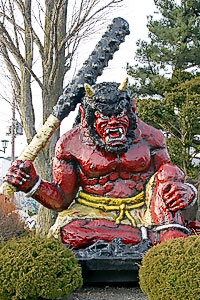
  1. Setsubun is the day before the first day of spring in Japan. It means "seasonal division" and is usually celebrated every February 3rd. The tradition is usually carried out by the male head of the household of the male toshiotoko and he usually throws soybeans out the entrance of the door or at a person wearing a demon mask. 
  2. Oni are a type of Japanese yokai or demon. They usually have human characteristics with unnatural characteristics like an extra finger.
  3. Kanabo are war clubs used by samurais in feudal Japan. The clubs are either spiked or studded and have to be wielded with two hands. They are often used by the oni.
  4. Syncretism is the combining of different schools of thought, for example, blending shinto beliefs with buddhism. 


"A statue of a red oni wielding a kanabo."
Posted by user Amcaja on Wikipedia.

Sunday, January 22, 2017

Wikipedia Trails: from Jack Kornfield to Abhijna

I always find myself with weird Wikipedia trails so I am so excited that Dr. Gibbs has decided to add this as an extra credit assignment! I saw Jack Kornfield on one of the newsletters so I will start there!

1. Jack Kornfield. Jack Kornfield is an American author and teacher in the Theravada Buddhism tradition. He studied under the master Ajahn Chah and is one of the few meditation teachers who helped introduce meditation to the Western world. He also became a monk for a little while and I am assuming he left monkhood to teach others. I found it was interesting that he studied under Ajahn Chah too because one of my favorite monks, Ajahn Brahmavamso, was one of Ajahn Chah's disciples. I also have heard to different kinds of meditation but never really looked into what distinguishes them. ONWARDS~

Photo of Jack Kornfield. 
Obtained from Jack Kornfield's personal Twitter account. Source: Twitter.

2. Vipassana meditation. Meditation that is focused on the mindfulness of breathing and of thoughts, feelings and actions that are used to gain insight into reality. It looks like that the practice is different under the different major Buddhist traditions like Theravada and Mahayana but the underlying purpose is the same: to gain insight. The few times I was able to practice meditation, it was mostly to pay attention to the breath and nothing else. I would like to give this a try soon.

3. Deva. A deva in Buddhism (I am assuming it is pronounced like diva... I hope I don't offend anyone by doing so) is a non-human entity that has god-like characteristics but are not gods themselves. They are said to be more powerful, longer-lived, and happier than humans. I think it's interesting that they are invisible to the human eye. Would that make them similar to benevolent ghosts or just spirits in a sense?

4. Abhijna. This is the Sanskrit word for "knowing" and it is a type of power that the devas can have. There are 6 types of higher knowledge "powers": higher power (such as walking on water), divine ear, mind-penetrating knowledge, recalling one's past lives, seeing the future, and extinction of mental intoxicants. Through meditation, the first 5 listed powers are achievable and the sixth power is the ultimate attainment. These powers would be cool to have. Maybe I should practice meditation more seriously!